 |
|
"Here
at last, a beautiful and sensitively written book on the exceedingly
important subject of dogs' emotional lives. It is high time that
somebody takes on the subject, and we owe a debt of gratitude to
Jeffrey Masson for doing so fearlessly, thoroughly, and lovingly."
"This
searingly honest appraisal of man's best friend will cause many
people to think about dogs in an entirely different way." Jeffrey
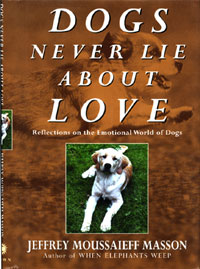
Masson does not lie about dogs" Order Dogs Never Lie About Love. |
by Jeffrey Moussaieff Masson
Excerpted with permission from Dogs Never Lie About Love
Copyright © 1997, Jeff Masson. All Rights Reserved.
Dogs do not lie to you about how they feel because they cannot lie about feelings. A dog can deceive another dog, but only about facts (pretending, for example, not to see a bone the other dog has temporarily left unattended), not about feelings. Nobody has ever seen a sad dog pretending to be happy, or a happy dog pretending to be sad. When a dog is sad or happy, that feeling occupies his entire being; the dog becomes pure happiness or pure sadness. As Roger Caras wrote in A Dog Is Listening: "A dog is utterly sincere. It cannot pretend.... People use you and pretend they don't, while dogs use you in complete honesty because they have no choice, and they have not an ounce of deceit in their soul nor self-consciousness about any of this."'
It is impossible to observe dogs for long without noticing what appears to be not only genuine emotion but distinctly canine emotions. When Sasha follows me from room to room, she seems to be expressing some emotional need that is not quite like any need we have. We are often too eager to explain away behavior that puzzles us with behavioristic clichés. It is not that Sasha is anxious or afraid I will disappear; to offer these as explanations is anthropomorphism. And even if we claim that what Sasha feels is instinctive, that does not negate its potency. Mothers feel instinctive love for their children, but the emotions are still powerful. In Sasha's case, I am convinced that some emotion is involved, but it is not dear which one.
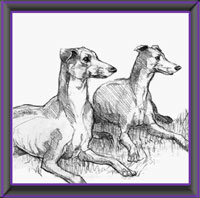
Sometimes the emotions of a dog are crystal clear. I drove to Gilroy, the garlic capital of the world, to see some greyhounds who had been rescued by a woman whose ranch had been turned into a sanctuary for them. These animals were in danger of being shot, either because they had lost a race or because they were not fast enough. Many people assume that because racing dogs make money for their owners, they are treated well. In fact, they are kept confined in small cages except for when they're racing, and are never shown any affection, on the grounds that they need to be aggressive to win and affection lessens the aggression. Racing greyhounds can reach speeds of forty miles per hour. Although gentle, they are never socialized and spend their entire lives in cages. After brief careers, they are no longer profitable and are difficult to place as pets, so they are often simply destroyed. It is truly a gruesome sport that allows this infamy. (1)
What struck me-indeed, what struck the woman who rescued the greyhounds-was their extraordinary forgiveness. They forgave all the terrible things that had been done to them. When you step on a dog's foot by mistake, somehow she knows that it was a mistake. The dog will immediately make up with you, lick your hand, and let you know that she holds no grudge. The greyhound does this at an even more profound level: "Yes, I have been beaten and hurt and I suffered. I remember, but I forgive. I want to be friends." I was so deeply impressed with the gentle demeanor of these animals that I wanted to take one home. As the dogs were brought out of their cages to see me, I found the way that each greyhound gazed up at me with absolute trust and sweetness to be almost unbearable. How could their friendliness have survived their traumas? Racing greyhounds are neglected and abused, then simply discarded, like so much rubbish, yet the emotion they so clearly manifest is forgiveness.
This nearly supernatural capacity to forgive was recognized in the very earliest writings about dogs. In 1842, in a strange book entitled Animal Biography, there is the following heartbreaking story from a French newspaper:
 |
|
Photo:
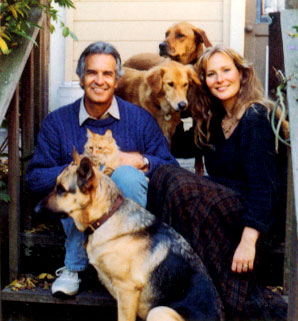
Daidie Donnelley Jeffrey Masson has a Ph.D. in Sanskrit from Harvard University and graduated from the Toronto Psychoanalytic Institute. He was briefly projects director at the Sigmund Freud Archives; the documents he found there on Freud's approach to child abuse created a major controversy in psychoanalysis. He has written more than a dozen books, including most recently the national bestseller When Elephants Weep: The Emotional Lives of Animals (with Susan McCarthy). Part of who Jeff Masson is. |
Mercifully we are spared from learning whether this cruel man found a less dangerous way to rid himself of his dog. Perhaps, though, this deed was able to touch his heart.
This drive to be friends is sometimes explained away as the need to be in a pack; to my mind it is more like an emotion incompletely developed in human beings--a yearning for friendliness. Eberhard Trumler ends his book Understanding Your Dog by stating that the true nature of the dog is an innate requirement for friendly contact with others. One is almost justified in calling this friendliness an instinct, since it is so hard to extinguish. When my three dogs run up to people and attempt to make friends, persisting even when the people strenuously avoid the attention, it always astonishes me. The parallel would be our approaching people at a cocktail party only to be yelled at and cursed, yet continuing to seek contact with them. It is more than just loneliness, or the desire to play, but some combination of the two that comprises another emotion altogether. Once again, the parallel with children is striking: Abused children often seek the protection of the very people who abuse them over and over again.
A dog 's capacity for friendship may indeed far exceed our own. Their primary friendships are with other dogs, then with humans, and sometimes with cats. Daniel Pinkwater, in The Soul of a Dog, told of how he once observed a dog, Arnold, taking care of an eight-week-old kitten. Arnold wanted to go and sleep in his private corner, but every time the kitten cried, he'd drag himself to his feet, slouch over to the kitten's cage, and lie down with his nose between the wires so that the kitten could sink its tiny claws into it. When the kitten became quiet, Arnold would head for his corner and flop, exhausted. As soon as the kitten started to cry again, Arnold would haul himself back to the cage.(3) From my own childhood, I know that dogs make friends with other animals, too, sometimes very odd ones (one of my childhood dogs would sit for hours in front of my hamster cage, seemingly entranced). I began asking people I knew whether they had direct experience of unusual friendships between dogs and other animals and was overwhelmed with a wealth of stories.
The most unusual friendship I have heard about was between a lion and a dog. Rick Glassey, who for twenty years has been training exotic cats for films (such as The Jungle Book), received a call one day from Lauri Marker, who worked in the Winston Wildlife Park in Oregon. She had a favor to ask of him. She was leaving for Africa to continue her study of cheetahs and wanted Rick to take one of her animals. "Sure, no problem' said Rick. "What have you got?" Just a dog. A Rhodesian Ridgeback, a female, about a year and a half old. Rick liked dogs and was willing to help. Rhodesian Ridgebacks originate from South Africa, where once they were bred to hunt lions. They are large, brave dogs, wonderful with people, but fearsome in the field. One other thing, added Lauri: The dog comes with his best and only friend, a lion called Wazoo.
It seems that the lion was housed from the day he was born with a family of dogs: the mother, a Rhodesian Ridgeback, and her four puppies. The father was probably a Border collie, and the puppies were smaller-than-normal Rhodesian Ridgebacks. They were a few months older than the lion. The dogs and the lion had grown up together as brothers and sisters. One puppy in particular seemed even closer to the lion than to her own littermates. This was the puppy Lauri wanted Rick to take, along with the lion. The puppy had grown into a handsome bitch, weighing about fifty pounds. The lion was also handsome, but he was enormous, weighing more than five hundred pounds.
Rick agreed and accepted both animals. He took Janee, the female Rhodesian Ridgeback, and Wazoo, the lion, to a preserve in Soledad Canyon, California, just north of Los Angeles. Shambala Preserve was founded and is now directed by Tippi Hedren, the actress who played in Hitchcock's The Birds and now has dedicated her life to helping lions, tigers, leopards, and other big cats who have not been able to find homes. There the two lived in a one-acre compound with a river running through it.
The lion and the dog Janee (an African word meaning both yes and no) were inseparable friends. The lion would spend hours licking the dog's ears and face, and when he had finished, she would begin grooming him all over his enormous body. At night they would sleep in a tight ball, each holding on to the other. How could this unlikely bonding be? Rick explained to me that it wasn't only out of pure love that they stayed together and remained as bonded as they did. No doubt the lion loved the dog and the dog loved the lion, but there was something else at work here, at least in his opinion, and being one of the world's foremost trainers of wild cats, he has some authority in the matter.
Rhodesian Ridgebacks are famous for their ability to bluff. Lions come from tight-knit social groups, the lion pride, consisting of between four and twelve related adult females, their offspring, and one to six adult males. In the pride hierarchy plays an important role. Every animal needs to know where he or she stands in rank, and it is rare that any attempt would be made to break out of that rank. Somehow Janee had convinced the lion that she was his superior, that she was dominant over him. During the early years of their time together the lion completely accepted this as inviolable fact. The dog was his boss, no question about it.
The smallish dog, on the other hand, knew that she was physically far inferior to the five hundred pounds of solid muscle that was her best friend. Nonetheless, she had a mental toughness that allowed her to insist on being deferred to by the larger animal. it allowed her to maintain her edge over him. She demanded respect, and she got it. Wazoo was very good-natured and rarely did anything to offend the dog. If he did, Janee quickly brought him around: She would attack him with fierce barking, snarling, growling, and even occasional bites to the ear. The lion would slink away, apologetic for having annoyed his friend and master.
For seven years the two animals romped and played and got intense pleasure from each other's company. Is it possible that the dog believed she was a lion, and the lion believed he was a dog, or were they simply not aware of any species barrier? They would eat together, though if push came to shove, Janee got the lion's share. They would split a baby bottle of milk, each licking from it at the same time. If the dog had to leave the large fenced-in area for any reason, the lion would begin to pace up and down, manifestly anxious. He found the separation unbearable. There was no doubt that Wazoo missed Janee. When his friend returned, he would greet her as if she had been gone for years, running up to her and licking her from head to toe, as if to examine her and make sure nothing bad had befallen her. Janee would wag her tail in ecstasy, equally happy to be back with her dose companion.
 |
What happened? How is it possible that these two lived like intimate friends for seven years, and then it all just came apart? It is impossible to say what was going on in the mind of the lion. The dog's fear was obvious, the lion's awakening more obscure.
Wazoo still lives by himself at the Shambala Preserve, sleeping peacefully as lions will most of the day. Janee is living with Rick's father-in-law in Ukiah, in Northern California, a dog who loves being a dog now and is best friends with her human companion.
I wonder if either animal is ever nostalgic. Does the dog think back with longing for the day when her closest friend was a lion? Does the lion ever wonder why he spoiled a beautiful friendship?
Memory and emotions seem linked together in the dog just as they are in human bein s. Do s dearly like seeing people they recognize. I took Sasha to the Oakland Home for Jewish Parents, to see Kucci, my ex-mother-in-law, a Polish Jew who survived the Holocaust in the Warsaw Ghetto. Kucci is eighty-six, has suffered three strokes, and cannot speak or move. It is hard to know how much she understands, though I suspect that she understands a lot more than commonly supposed. One of the activity assistants took Sasha to see each and every resident of the back ward, the people who can no longer feed themselves or communicate with others. She paid attention to each person in turn, as if she knew that special kindness was required of her in this situation, but she was at her best when she saw Kucci: She tried to jump up into her wheelchair and lick her face. Kucci was thrilled. I saw her laugh, really laugh, for the first time in ages. Sasha did not do this with any other resident. Clearly she recognized her from the two earlier times we had visited. Beyond some early German work, I know of no contemporary research having been done into memory in dogs. But most dog caretakers I've spoken with think dogs are like people in this respect, that their memory depends on how interested they are. Sasha clearly felt pleasure at seeing Kucci, probably the pleasure of recognition. Perhaps it makes a dog feel safe to repeat an experience, especially one that brings with it good sensations.
Sima, the golden retriever sheltie mix, squeals with delight when she recognizes somebody. I have never seen her fail to do this. Clearly she is remembering. The very act of remembering seems to give her pleasure, for even when she has no particularly close relationship with a person but merely remembers seeing them earlier, she begins her little dance of delight. She invariably rushes off to get a favorite toy and brings it to the visitor in her mouth as a kind of offering, squealing and making strange little sounds of joy in her throat. Nostalgia in people provides a particular kind of pleasure. Visiting the small town in which we grew up, seeing the houses now inhabited by a completely different set of people, can evoke very strong feelings based on memories that may not even surface. When we think back on events, they often appear suffused with romance and mystery, even though at the time they may have seemed banal. Dogs seem to carry this ability to marvel at everything past to an even greater degree: For a dog, every memory is a delight.
Some people have questioned whether dogs, like humans, can have feelings of which they are unaware. The notion of unconscious emotions is a familiar paradox. How can we have a feeling and yet not know that we feel it? Is it not in the very nature of a feeling to be consciously felt? Freud noted the paradox but nevertheless maintained that it is in fact characteristic of humans that they are often unaware of what they are feeling. By now we are accustomed to the notion of unconscious aggression-somebody who bears us ill will but does not know it. Depression, too, can be felt but not recognized, and even denied by the person who is in the grip of it.
 |
The idea of an unconscious emotion, like the unconscious in general, depends on a particular mechanism humans use to defend themselves against hurt: repression. When a thought, memory, or feeling becomes unbearable, we put it out of consciousness, we repress it; dogs lack this luxury. I do not believe that dogs are capable of repression, that they can feel sad or happy and not know it. There is a sense in which the dog is his feelings, whether sad or happy. Much as he might wish he could, he seems incapable of denying how he feels. This provides much of the pleasure of being in the company of dogs. As Mike del Ross, of Guide Dogs for the Blind, said to me, "Dogs never lie about love." This is also the opinion of Anatole France, who asks what could be "the meaning of the obscure love for me that has sprung up in your little heart?" It is a mystery he accepts.(4)
Dogs do not lie to you about how they feel because they cannot lie about feelings. A dog can deceive another dog, but only about facts (pretending, for example, not to see a bone the other dog has temporarily left unattended), not about feelings. Nobody has ever seen a sad dog pretending to be happy, or a happy dog pretending to be sad. When a dog is sad or happy, that feeling occupies his entire being; the dog becomes pure happiness or pure sadness. As Roger Caras wrote in A Dog Is Listening: "A dog is utterly sincere. It cannot pretend.... People use you and pretend they don't, while dogs use you in complete honesty because they have no choice, and they have not an ounce of deceit in their soul nor self-consciousness about any of this."(5)
An interesting facet of canine emotional life is the emotions dogs don't seem to experience, such as the self-referential emotions. They do not seem to feel self-pity, for example. While walking the dogs on the University of California campus in Berkeley, I saw a black Labrador mix chasing a Frisbee down a hill. He looked joyous and completely absorbed in what he was doing. When he ran down the hill, I noticed with a shock that he was dragging his two hind legs behind him. They were in fact paralyzed. His companion, a graduate student in English named Victoria Pond, told me Cinder did not seem to notice that he had a disability, much the same way as children can seem oblivious. He had been struck by a mysterious virus a year earlier, when he was ten months old, which left his whole back side paralyzed. He wears special boots that protect his feet and part of his legs from the abrasions he would otherwise receive from dragging them on the ground. In spite of these disadvantages he was happy--and my dogs were delighted to play with him. They either did not notice his disability or thought nothing of it.
How different from us! Many people who experience lesser loss than this would whine and curse the heavens like regular Jobs: "'Why me? Why do I have to suffer this?" We would feel sorry for ourselves. We would feel, above all, self-pity. But for this dog it was just something that he lived with. He seemed totally unaware of being different from any other dog, and was clearly determined not to let the disability interfere with his capacity to enjoy life. His emotions were so clearly in the present that nothing could interfere with them, not any past event nor any thought of how he differed from other dogs.
An astonishing story, graphically illustrated with photographs, appeared in a German research journal concerning a German shepherd, Rolf, who lived with a railroad-crossing guard and his family in 1929. The dog constantly accompani I ed the children everywhere. One day, while walking across the tracks (possibly he was trying to protect the children from an oncoming train), he was struck head on by a train, which took both his left legs off cleanly. The children ran back to their mother, who found the dog, evidently dead. She dragged him to a wood pile. But when the guard went out to see for himself, he found that the dog had regained consciousness and had dragged himself into a cave that was lined with straw. Amazingly, the dog lost less blood than might be expected. He licked the wound steadily for days (more proof that dogs' saliva has healing properties--an old wive's tale that I happen to believe is true) and seemed to get better. Yet the stump on the back leg was in very bad shape, with bits of bone splinter hanging out. The dog himself pulled them out of the suppurating wound with his teeth. Two days later, to everybody's astonishment, he appeared "on his feet" in front of the house. Within three weeks the stumps were totally healed, and he was like his old self: He played with the children, guarded the house, and was a spectacular rat-catcher. He began to enjoy swimming again, took to running faster and faster, even jumped over ditches--all on two legs. When he came to the burrows of rabbits, he would try to dig them out, but would of course immediately fall onto one side. Not to be beaten, he soon learned that he could stick his whole head into the warren and bite the earth. The accident left him with no visible fear of traffic or of trains. He would still run alongside the trains, barking as he had done before the accident. So astonishing was the behavior and plasticity of this dog that he 'was given to the dog-training unit of the German army for a study.
The military dog trainers decided that perhaps the animal was subject to retrograde amnesia, so great was the shock he had suffered after the accident, and remained unaware of what had happened to him. He never walked again, but only galloped, even when he was standing still. Put to the test to see how well he would perform on the various obstacle courses they had prepared for their own dogs who were used in war, Rolf was able to accommodate his own handicap. He learned to climb stairs, and even a ladder, to walk over a narrow gangplank across a deep ditch, and to go into pitch-dark caves.(6)
In an early play, Raphael says to Hypatia: I took her, my dog, for my teacher, and obeyed her, for she was wiser than I, and she led me back, the poor dumb beast, like a God-sent, and God-obeying angel, to human nature, to mercy, to self-sacrifice, to belief, to worship, to pure and wedded love.."(7)
I am not alone in my love for dogs: Thirty-five percent of American households owned a dog in 1994, representing a dog population exceeding 52 million.(8) It hardly seems worth asking the question of why we love them, so obvious does the answer appear to all: We love dogs because they love us, unconditionally. No matter how we treat them, what we do to them, how little attention we pay to them, they are eager to please us, eager to be with us. I asked this question of Craig Stark, a dog expert from the Los Angeles-based Last Chance for Animals who has done a great deal of work trying to stop pet-dog theft, and he had a wonderful response: "It is the only love money can buy."(9) Dogs are ready, to the point of cosmic love, to forgive anything we do to them.
Many writers have noted that we speak to dogs much as we speak to children: Our voices become high-pitched; we lean down close to them; we touch them as we talk; we play word games, give them alternate names, coo, sing, chant, and lose ourselves in a more innocent world. We are surprised when a child tells us that we are boring. We do not expect to be judged--and a dog, with very few exceptions, will never judge us.(10) When asked why they love their dog, many people will bring up this point. In fact failure to judge our actions is no reason for loving anybody. In a person, such nonjudgmental behavior would strike us as either apathy or immoral. A dog, on the other hand, somehow belongs to another realm or a different world. Dogs make certain distinctions, but in dog terms, and we may never know how our dog sees us in that language. We don't have access to it. Moreover, just as we might think one thing but feel another, loving the person but hating what he does, so might the dog disdain how we act but love us nonetheless.
 |
And when we bury our face in our hands and wish we had never been born, they don't sit up very straight and observe that we have brought it all upon ourselves. They don't even hope it will be a warning to us. But they come up softly, and shove their heads against us ... he looks up with his big, true eyes, and says with them, "Well, you've always got me, you know. We'll go through the world together, and always stand by each other, won't we?"(11)
There may be another reason why so many people love, dogs with passionate intensity. Men who gradually become misanthropes explain their distaste for other people (misanthropy rarely extends to include the speaker) with a reference to selfishness, to the fact that so many human beings seem absorbed in their own affairs, self-preoccupied, obsessed with matters that refer to them exclusively. Narcissism has become the great catch-all term of opprobrium to describe man in the twentieth century. This is, I think, by and large true: Some people do have a remarkable ability to remain fascinated with the minutiae of their own lives, which others find puzzling, inasmuch as they reserve such fascination for their lives.
Humans have a tendency to immerse themselves in their own narcissistic concerns, losing awareness of the world around them. Not only pity for the self, but self-concerns of many varieties, preoccupy us. Perhaps one central reason for loving dogs is that they take us away from this obsession with ourselves. When our thoughts start to go in circles, and we seem unable to break away, wondering what horrible event the future holds for us, the dog opens a window into the delight of the Moment. To walk with a dog is to enter the world of the immediate. Our dog stares up into a tree, watching a squirrel--she is there and nowhere else.
"What are dogs interested in?" asked Elizabeth Marshall Thomas, who came up with the obviously correct answer: other dogs. But not just that. I have watched the faces of my three dogs freeze with intense interest; whatever the task at hand is, they bring such focused intensity to it. They turn to watch which way I will go at a fork in the road. They are so interested. It is extraordinary how much interest they can invest in the most ordinary thing. I find it entirely humbling. That concentrated, full, complete, undisturbed interest is what everybody wants from their own human companion.
Rani almost never stops wagging her tail. She seems to be pure happiness, all the time, everywhere--as long as she is outdoors. We humans are artificially confined, even though we confine ourselves. Our light is artificial, as is our food, our clothes, and much of our conversation, as well as the objects that surround us, cars, docks, computers, and washing machines. When we are out with our dogs, we are able to leave this world of artifice behind. Many people report the therapeutic effects of walking with a dog, how it is stimulating and soothing at the same time.
I dispute the philosophical claim that dogs have no conception of time, but there is a sense in which this claim is true: Dogs do not appreciate time that is set by convention; they do not divide a day up into minutes or hours, nor do they think in terms of weeks or months or years. A dog does not tremble at the thought of his own mortality; I doubt if a dog ever thinks about a time when he will no longer be alive. So when we are with a dog, we, too, enter a kind of timeless realm, where the future becomes irrelevant.
When I was growing up, my family habitually judged one place in comparison with another from their memory. The present, of course, could never compete with the past, especially an idealized past. I, too, picked up this bad habit. A close companion would often have to admonish me: "Why do you compare one beach to another? You are here now; enjoy it for what it is." I learn the same lesson from watching my dogs: They are never paralyzed by the need to judge and to compare. They are never gloomy at the thought that this walk was not as nice as yesterday's walk, this forest not nearly as interesting as last week's forest. Each walk is new, unique, and uniquely interesting, with its own set of smells and delights. I keep looking for my dogs' favorite walks, but the truth is, they have no favorite walks; only I do. They love all walks. They love walking. They love being wherever they are. The reason, and it is a great lesson, is no doubt that they are perfectly content to be who they are, without torturing themselves with alternatives: They love being dogs.
Marjorie Garber speculates that dogs allow us to fantasize about spontaneity, emotional generosity, and togetherness. This is right, partly I think because dogs "are strangers to cynicism.(12) Dogs are not worried about how they will be perceived by other dogs. They do not have to hide their joie de vivre for fear of appearing naive, and they do not need to feign boredom when they are in fact interested for fear of appearing unsophisticated. Dogs never stand around at parties wondering what to say, or why they came, or how pitiful they might seem to more elegant or more amusing or more important guests. They do not struggle to be witty, getting right to the point, going straight for the source. Yet they manage to come away with a greater and more accurate fund of information than humans do at their parties. For the dog sex may or may not be present, in deed or thought, but information, knowledge, is critical: What kind of dog am I dealing with? Who stands before me? Where have you been and what did you do there? But even more basic: Who are you really.?
Questers of the truth, that's who dogs are; seekers after the invisible scent of another being's authentic core.
FOOTNOTES
1. Roger Caras, in his introduction to Beautiful Joe by Marshall Saunders, points out that racing greyhound breeders still kill fifty thousand perfectly healthy dogs every year because they can no longer perform at the track. Back
2. Animal Biography, London: G. Virtue, 1840, p. 79. The book is anonymous. Back
3. Cited in Winokur, Mondo Canine, p. 248. Back
4. France, "The Coming of Riquet," p. 86. Back
5. Caras, A Dog Is Listening, p. 52. Back
6. Brückner, "über einen zweibeinigen Hund," Zeitschrift für'Hundeforschung 13 (1938): 1-16. Back
7. 1 have taken this quote from the fascinating early article by W. Fowler Bucke "Cyno-Psychoses: Children's Thoughts, Reactions, and Feelings Toward Pet Dogs" The Pedagogical Seminary 10 (1903): 459-513. The quote (page 509) is from the children's writer Charles Kingsley (1819-75), author of Water Babies. Back
8. Wise and Yang, "Dog and Cat Ownership, 1991-1998," Journal of the American Veterinary Association 204 (1994): 1166-67. Back
9. This is also the theme of a poem quoted by E. V. Lucas, "The More I See of Men" (which I have-taken from Vesey-Fitzgerald's Animal Anthology, p. 86), which begins with the lines:
A heart to love you till you die--
That's the thing that money can buy.
and ends with these Iines:
Wherever dogs are offered for sale,
These are things that money can buy. Back
